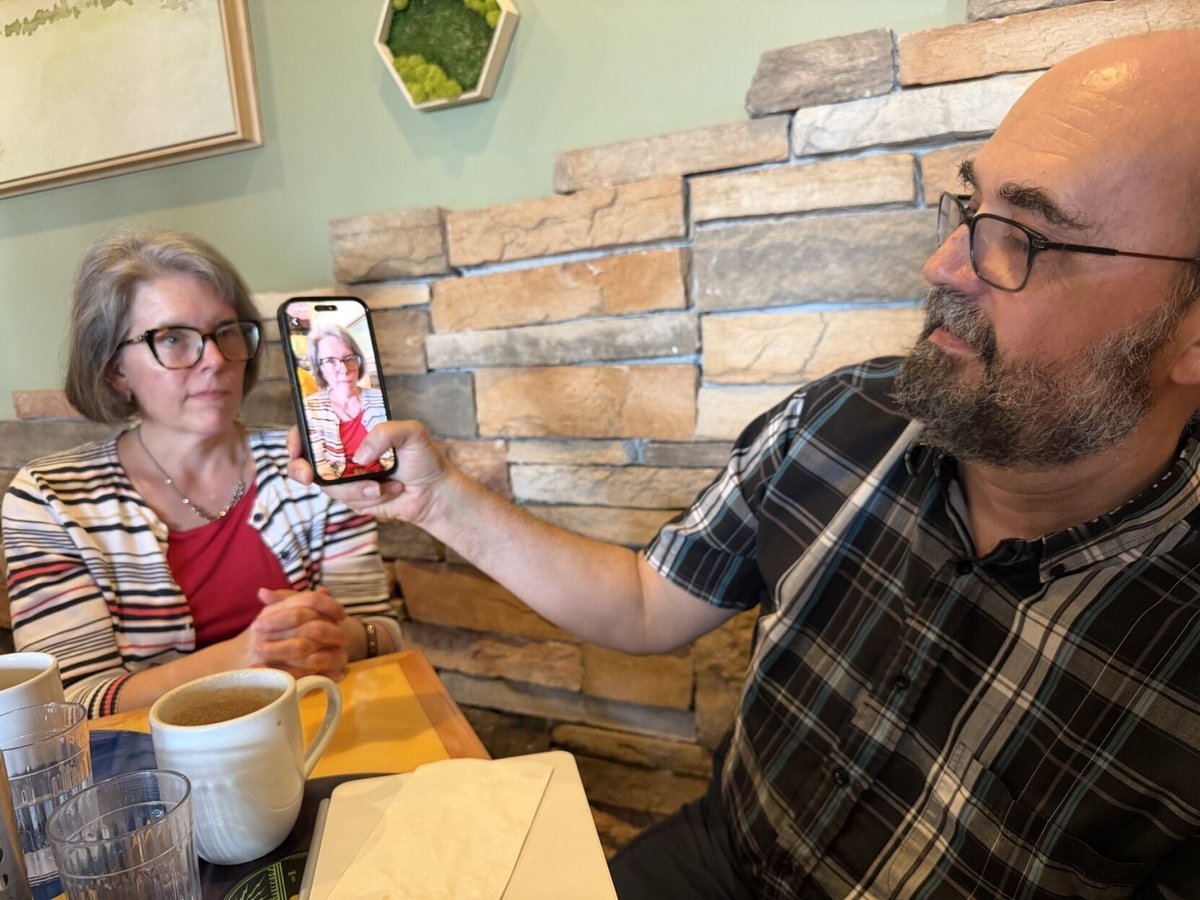
Dynaface began as a personal project. When Jeff Heaton's wife, Tracy, developed facial paralysis and was treated at Johns Hopkins, Jeff, whose work is in artificial intelligence, built a tool to measure facial symmetry from ordinary photos and video. That project grew into the research collaboration with the Johns Hopkins Department of Otolaryngology–Head and Neck Surgery that continues today, and Dynaface is now free and open source for anyone to use.
In August 2026, St. Louis Post-Dispatch columnist Tony Messenger told the story. The excerpt below is published with the newspaper's permission; the full column is on stltoday.com.
In August of 2021, Tracy had surgery to remove a benign brain tumor. The tumor was touching her acoustic nerve. But the facial nerve is very close to where the tumor was, and it was damaged during surgery. When Tracy woke up, the left side of her face was frozen in place, similar to what often happens to stroke victims or people with Bell’s palsy.
[…]
After Tracy’s surgery, Jeff got to work. He took her photos and loaded them on his laptop. He started playing with ways he could measure changes to her face, to determine if she was showing improvement.
Meanwhile, he also researched the best doctors to help treat her condition. Time was of the essence. Jeff knew that if they didn’t act quickly, the muscles in Tracy’s face might atrophy. In October, just a couple of months after the surgery, they met with Dr. Kofi Boahene, an expert in facial reanimation at Johns Hopkins University.
[…]
During one of the couple’s visits with Dr. Boahene to check on Tracy’s progress, Jeff showed the doctor what he was developing on his laptop: a program to measure miniscule changes to his wife’s facial expressions. For the doctor, it was a “eureka” moment. No such application existed, and Jeff had figured out how to make sure the measurements from the photos were precise.
Dynaface was born.
It’s an application developed by Jeff and Johns Hopkins researchers that is now available for mobile phones — free in various app stores. It allows patients or doctors to take photos and measure changes in recovery for people who have suffered from some form of facial paralysis. Johns Hopkins doctors are researching its full capabilities and have already written two papers on their findings.
Excerpted with permission from “Chesterfield man uses AI skills for medical app to help his wife and others” by Tony Messenger, St. Louis Post-Dispatch, August 16, 2026. The full column is available to subscribers at stltoday.com.
More of the story
Jeff Heaton's own account of the project, written with John Agliata, Finding Her Smile, was published by RGA in April 2026, and other coverage is listed on the Media page. For how Dynaface works and the studies that use it, see Research.