
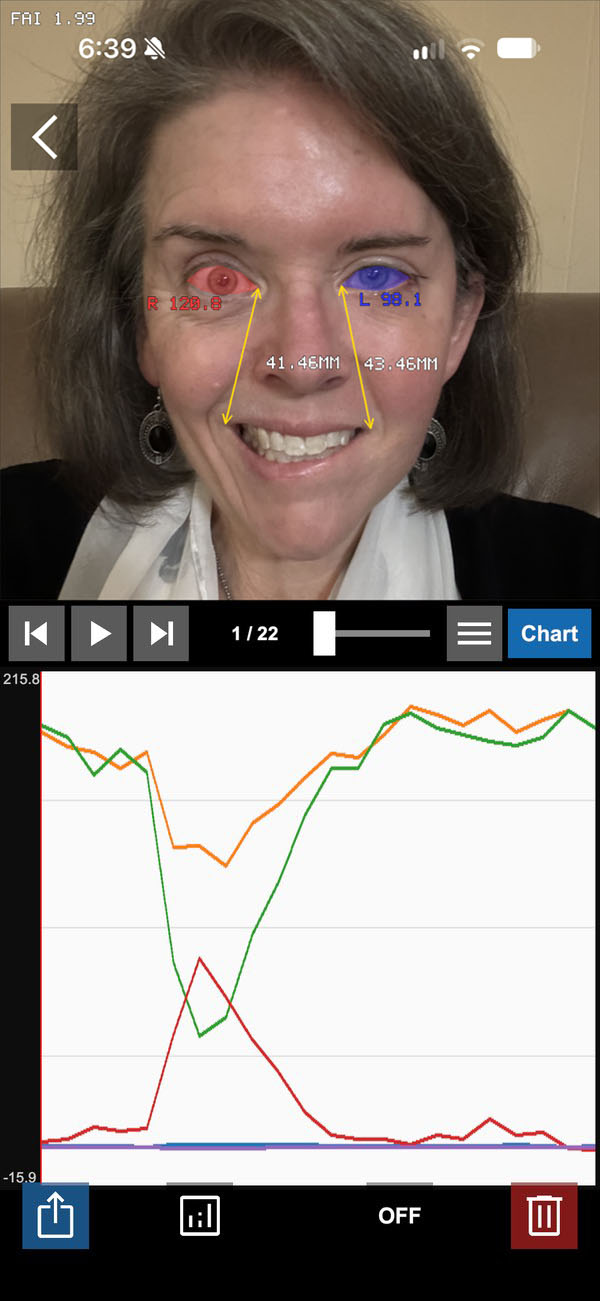
Dynaface is free, open-source software for objective measurement of facial symmetry and facial movement from photographs and video. AI places 98 facial landmarks automatically and computes established measures such as the Facial Asymmetry Index (FAI), oral commissure excursion, brow height, eye area and dental display, plus nasofrontal and nasolabial angles from profile views. In video, every frame is measured and charted, so blink and smile cycles can be compared side to side, and all values export to CSV for statistical analysis.
Dynaface has been used in peer-reviewed studies of idiopathic facial paralysis (Laryngoscope, 2026), oral-ocular synkinesis, and facial weakness in facioscapulohumeral muscular dystrophy (FSHD) (Facial Plastic Surgery & Aesthetic Medicine, 2026); see Research.
Dynaface is developed in collaboration with the Johns Hopkins Department of Otolaryngology–Head and Neck Surgery, including its Division of Facial Plastic and Reconstructive Surgery. The people behind Dynaface are listed on the Contributors page. All processing happens locally on your own machine — no image or video data is uploaded anywhere. See the story behind Dynaface for background.
Dynaface is a research tool and is not a registered medical device; see Legal for details.
Get Dynaface
Android is a direct download rather than a Google Play listing; the Android page explains why and walks through the install.
Documentation and Libraries
- User's Guide for Windows and macOS — the desktop app manual.
- User's Guide for iPhone, iPad, and Android — the mobile app manual.
- Python library — scriptable access to the same measurements.
- .NET library — for C# and other .NET applications.
- Source code — released under the Apache License 2.0.
For how Dynaface works under the hood and the peer-reviewed studies that use it, see Research.